Where Can I Find a World Stamp Catalogue?
A world stamp catalogue is a reference work that lists postage issues country by country. It gives each issue an identifying number, a description and a guide value. Printed editions sit on the reference shelves of many public libraries and in the libraries of philatelic societies and stamp clubs. Dealers and booksellers sell them, and some publishers offer digital versions. This guide explains what each source gives you, how to choose between a full world set and a single-country volume, and how to read the numbers once you have the catalogue open. It also covers when to stop searching and ask someone experienced.
Quick answer: Check the reference section of a public library, a philatelic society or stamp club library, a stamp dealer, or a secondhand bookseller for printed editions. If you prefer to read on a screen, some publishers sell digital editions of their catalogues.
What a world stamp catalogue contains
A world catalogue tries to list every postage stamp issued by every postal authority. Entries are grouped by country and then put in date order. Each entry usually gives a catalogue number, the denomination, the colour, a short description of the design, the date of issue and a value for unused and used copies. Many entries are illustrated. Notes explain varieties that share a design but differ in printing, paper or colour.
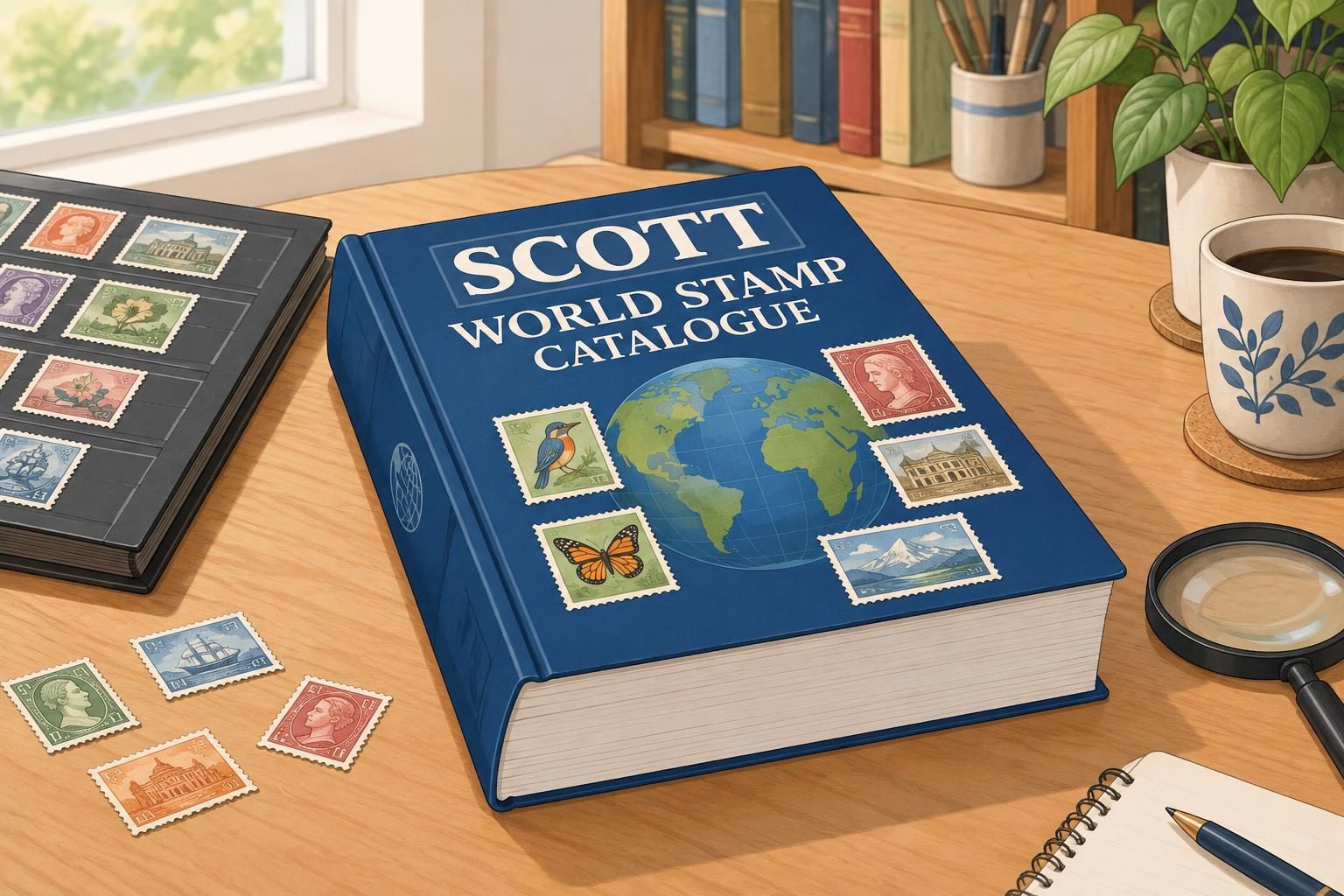
In the United States, many collectors and dealers use the Scott catalogue as their standard reference. Its history shows how these books grew. John Walter Scott [1] published his first list in September 1868 [1] under the title Descriptive Catalogue of American and Foreign Postage Stamps [1]. That first edition was a 21-page pamphlet [1]. The modern standard edition fills fourteen large volumes [1]. A complete world catalogue is therefore a shelf of heavy books, so you may not want to buy or carry the whole set.
That size affects where you go to consult one. Each volume covers only part of the alphabet of countries. A library or club that owns only some of the volumes may not have the pages you need. Before you travel, ask which volumes and which edition they hold, so you do not make the trip for nothing.
A catalogue value is a guide, not an offer to buy. It reflects the publisher's view of what a stamp in a stated condition might sell for, and real sales often come in lower or higher. If value is the reason you want a catalogue, read how to determine stamp market value as well.
Free places to consult a catalogue
You do not need to own a catalogue to use one. Several places keep copies that you can read without buying anything.
- Public libraries: larger branches and central libraries often keep a recent edition on the reference shelf. These copies usually cannot be borrowed. Plan to work through your stamps at a library table. If your branch has none, ask a librarian whether another branch in the system holds a set or whether an interlibrary request is possible.
- Philatelic society libraries: national collector organisations run research libraries. Examples are the American Philatelic Research Library and the library of the Royal Philatelic Society London. These collections often hold long runs of older editions and specialised single-country catalogues. Access rules differ, and some services are limited to members, so read the library's own terms before you visit or write.
- Local stamp clubs: many clubs own a few volumes, and members often bring their own copies to meetings. Experienced members can also show you how to read the listings.
- Stamp shows and dealers: dealers keep catalogues at their tables because they price from them. Many will let you look up an entry if you ask politely and do not hold up their customers.
Tip: Before a library or club visit, photograph each stamp on a plain background and number the photos to match a written list. You can then work from the pictures at the table, write the catalogue reference beside each number, and leave the stamps safely at home instead of carrying them into a busy reading room.
University libraries with postal history or design collections sometimes hold catalogues too. These copies are often for reference use only, so check opening hours and visitor rules first.
Buying, borrowing and digital stamp catalogue options
If you collect regularly, you may want a catalogue at home. You have three main routes: a new printed edition, an older secondhand edition, or a digital version.
A new printed edition gives you current numbers and current values. You rarely need the whole run of fourteen large volumes [1]. The volumes are split by groups of countries, so you can buy only those that cover what you collect. Publishers also issue specialised catalogues for single countries or topics, and these go into more detail on varieties.
Secondhand editions turn up at dealers, club sales and used booksellers. They still show the designs and the numbering of their time. Keep in mind that any printed book records the publisher's view on the day it went to press, so later additions, renumbering and value changes will not appear in it. If you are unsure whether an older book suits your purpose, ask a dealer or club member which edition they work from.
Digital editions save shelf space and can be read on a screen at home. Pictures matter here. In May, 2001 Scott announced a project to include a scan of each stamp in its catalogues [1]. A picture beside each listing shows exactly which design the entry refers to, which a written description or an old black-and-white cut cannot always do.
Think about how you will use the book before you choose. A mixed box of stamps from many countries calls for the general world volumes. A collection built around one country is better served by that country's volume or a specialised catalogue, which spends more pages on the issues you own.
| Source | What you usually get | Points to weigh |
|---|---|---|
| Public library | Printed volumes on the reference shelf | Often cannot leave the building |
| Philatelic society library | Current and older editions, specialised volumes | Access may depend on membership |
| Stamp club | Shared volumes at meetings | Editions may be a few years old |
| New printed edition | The full fourteen large volumes [1] or single volumes | Takes shelf space; values change each edition |
| Secondhand edition | Older volumes from dealers or booksellers | Numbers and values may have changed |
| Digital edition | Files from the publisher, read on a screen | Usually tied to an account |
How to read Scott catalogue numbers
Once you have a catalogue open, the numbers tell you a lot about what kind of stamp an entry describes. The Scott numbering system assigns plain numbers for regular mail stamps, and uses capital letter prefixes for special-purpose types, such as "B" for semi-postals and "C" for airmail [1]. A semi-postal is a stamp sold for more than its postal value, with the extra going to a charity or cause. Each country's listing therefore has several runs of numbers: the regular issues first, then separate sections for each special type.
This layout tells you where to look. If you already know a stamp is an airmail issue, its listing sits in the C run for that country rather than among the regular issues, and a semi-postal sits in the B run [1].
Minor variations, such as shades or errors, get a lowercase letter [1]. That letter follows the main number. It means the item is a recognised variety of the basic stamp rather than a separate design. Error stamps, including inverts, can appear this way. Our guide on how to identify inverted stamp errors covers that topic in more depth.
Understanding this system also helps when you read dealer lists, auction descriptions and club exchange sheets, which often quote these numbers. A capital prefix points to a special-purpose issue, and a lowercase letter after the number points to a listed variety of a basic stamp [1]. With that in mind, you can tell from the number alone whether a lot is described as a regular stamp, an airmail, a semi-postal or a variety, before you even look at the picture.
When the catalogue alone does not settle it
Every world catalogue is arranged by country, so you need at least a likely country before you can pick up the right volume. Some stamps carry the country name in a local language or script, and a few carry none at all. Our guide on how to identify a stamp's country and year covers that question in detail. If you still cannot place a stamp, an experienced club member or dealer is the person to ask, and many can name a country quickly from long familiarity.
You may also reach a point where two or more entries look the same to you. The difference between them may lie in details that take training and equipment to confirm. Do not guess, particularly when the entries carry very different values. Ask an experienced club member, a reputable dealer or a philatelic society's expertizing service for an opinion before you price or sell the stamp.
If you cannot find the stamp at all, it may not be a postage stamp. Revenue stamps, charity labels, local posts and private issues often fall outside a general world catalogue, or appear only in specialised books. A specialist society for that country or subject is usually the right place to ask.
If you collect covers, the catalogue may list the stamp, but the envelope itself can matter as much. Read how to identify a first day cover stamp before you remove anything from an envelope.
When you do ask for help, bring clear photos of the front and back of the stamp, note where it came from, and say which catalogue and edition you have been reading. That gives the person helping you a clear starting point and saves time for both of you.
Common mistakes when using a world catalogue
Collectors new to catalogues tend to make the same handful of errors.
- Treating catalogue value as a selling price. Dealers usually buy well below catalogue, and common stamps may sell for far less than their listing suggests. The listed figure also assumes a stated condition, and a thinned, torn or heavily cancelled copy will not reach it. Our guide on how experts grade stamp condition explains what condition terms mean.
- Looking only at the regular issues. An airmail or semi-postal will never turn up there, because these sit in their own prefixed runs [1].
- Reading too much into colour. Light, age and exposure change how a colour looks. A faded stamp is not the same thing as a listed shade.
- Assuming every oddity is a variety. Recognised minor variations carry a lowercase letter [1], but a stain, gum mark or small flaw on one copy is not the same thing. If you think you have a variety, have it examined by someone experienced before you price it.
- Relying on an old edition for values. Older books are fine for learning designs and numbering, but their values reflect the market when they were printed.
- Buying more than you need. A whole world set is a large purchase, and a single volume covering your countries may serve you just as well.
Warning: Never trim, soak, press or clean a stamp to make it look more like the catalogue picture. Altered stamps lose much of their value, and a stamp still on its original cover may be worth more left in place. Handle stamps with stamp tongs, and keep them off the open pages while you search so that they do not slide into the binding or get creased.
A quieter mistake is stopping at the first close match. Several stamps in a set often share one design, and the catalogue gives each its own number. If more than one entry seems to fit, treat the identification as open and ask someone experienced before you write the number into your records.
Using Stamp Identifier alongside a catalogue
A catalogue lookup is quicker when you already have a likely country and issue in mind. Stamp Identifier lets you photograph a stamp and get an identification suggestion, including the country and issue details. Use that suggestion to choose the right volume and section, then check uncertain details against a catalogue. The app's estimated value is a starting point for research, not an appraisal or a guaranteed sale price. Its collection tools let you keep your photos and notes together while you confirm each entry in the printed or digital edition.
Common questions
- Is there a free world stamp catalogue I can use?
- Public libraries, philatelic society libraries and stamp clubs let you read printed catalogues without buying them. Dealers at stamp shows will often let you look up an entry if you ask politely. Call ahead to find out which volumes and edition a library or club holds.
- What should I do if my stamp is not in the catalogue?
- It may be a revenue stamp, a label or a local issue that a general catalogue leaves out. A specialist society or an experienced dealer can usually tell you what it is. Bring clear photos of the front and back when you ask.
- Should I buy an older edition of a world catalogue?
- An older edition is useful for learning designs and how the listings are arranged. Its values and some of its numbering may be out of date, because a printed book records the publisher's view when it went to press. If accurate values matter to you, consult a recent edition as well.
- Can I take a library copy of a stamp catalogue home?
- Many public libraries keep stamp catalogues as reference books that must stay in the building. Some society libraries lend to members under their own rules. Ask the library staff before you visit, and bring photos of your stamps so you can work efficiently at the table.