What Are the 10 Most Valuable Postage Stamps?
People who ask about the most valuable postage stamps usually want two things: the names that keep appearing in auction records, and a way to tell whether anything in their own album belongs in that company. This guide covers both. It explains why any top ten keeps changing, describes the items that recur on published rankings, and sets out what those items have in common. It then walks through the checks to do before you raise your hopes or pay a high price for a stamp.
Quick answer: No fixed top ten exists, but published lists consistently include the British Guiana 1c magenta, the Treskilling Yellow, the Mauritius 2d blue and the Inverted Jenny plate block. A rotating group of classic errors and early issues fills the remaining places as major items change hands.
Why no top ten of valuable postage stamps stays fixed
A ranking of the most valuable stamps is built from sales that were made public. An item moves up or down only when it changes hands at auction or through a reported private deal. Several of the famous pieces have stayed in one collection for long periods, so a list can look settled for years and then shift after a single sale.
Lists also compare different kinds of object. Some entries are single stamps. Some are blocks of stamps still attached to each other. Others are covers, meaning envelopes or wrappers that still carry their stamps and postal markings. A compilation such as the list of most expensive philatelic items [1] places all of these side by side. The answer to ‘which ten’ therefore depends on whether you count only loose stamps or every kind of philatelic item.
Time adds a third complication. Sales take place decades apart, in different markets and currencies, and a result from one period does not convert neatly into another. For that reason, this guide treats the top group as a set of names that recur across lists rather than a strict order from first to tenth. When a website presents a precise ranking, it usually reflects the particular sales its compiler chose to include, and whether that compiler treated covers as stamps.
Four items that appear on nearly every list
Four pieces come up repeatedly. Between them, they show the main routes to a very high value: a unique survivor, a colour error, an early colonial issue and a printing error preserved in an attached block.
| Route to a high value | Example on the lists | Why it matters |
|---|---|---|
| Unique survivor of an emergency printing | The British Guiana stopgap issue | No second copy exists to compare prices against |
| Printing in the wrong colour | The Swedish yellow error | The ordinary colour of the same value is common |
| Early locally produced colonial issue | The first Mauritius stamps | Few copies survived from short local printings |
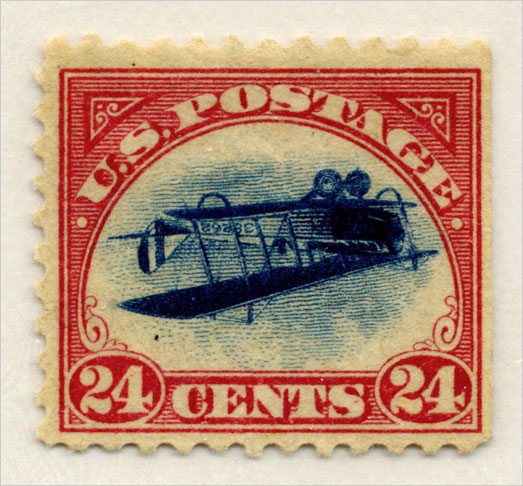
| Error kept as a joined block | The inverted US airmail block | Most error copies were separated into single stamps |
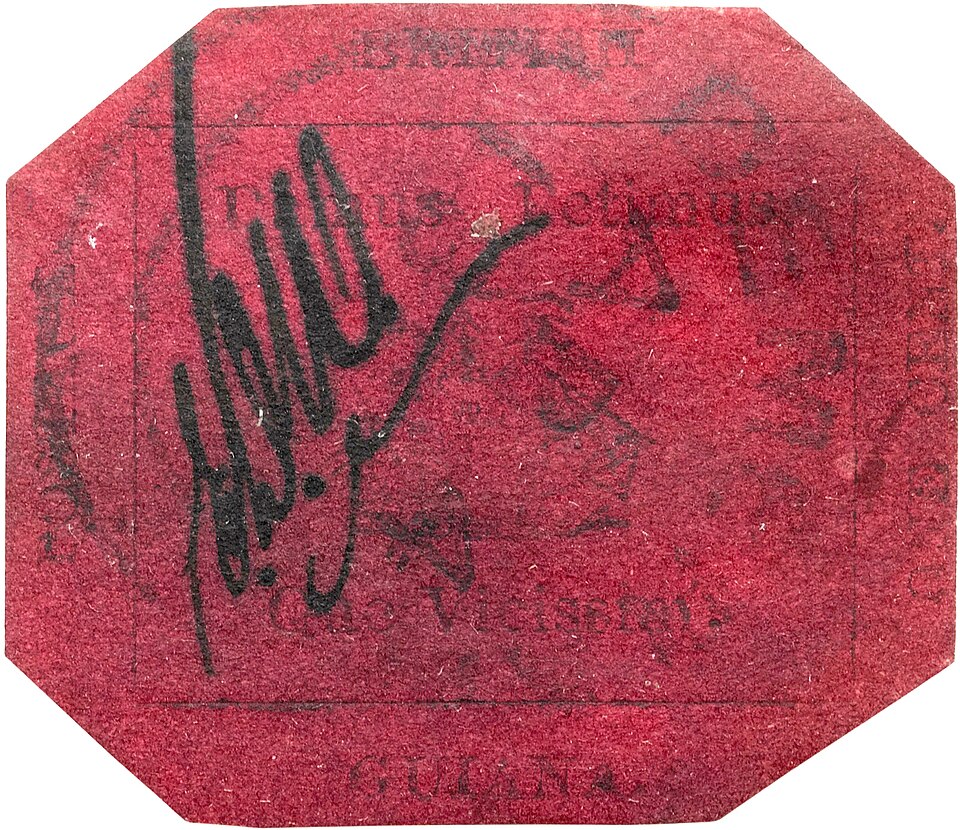
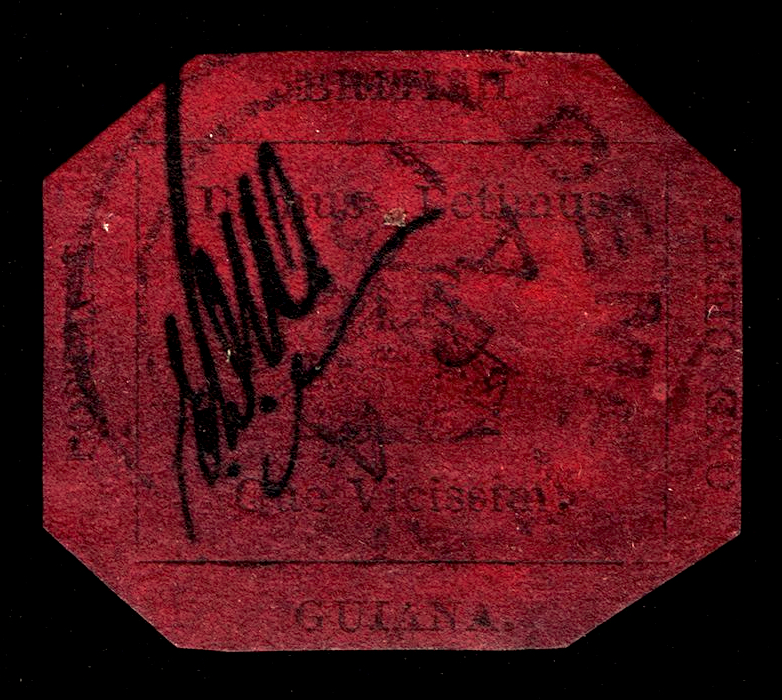
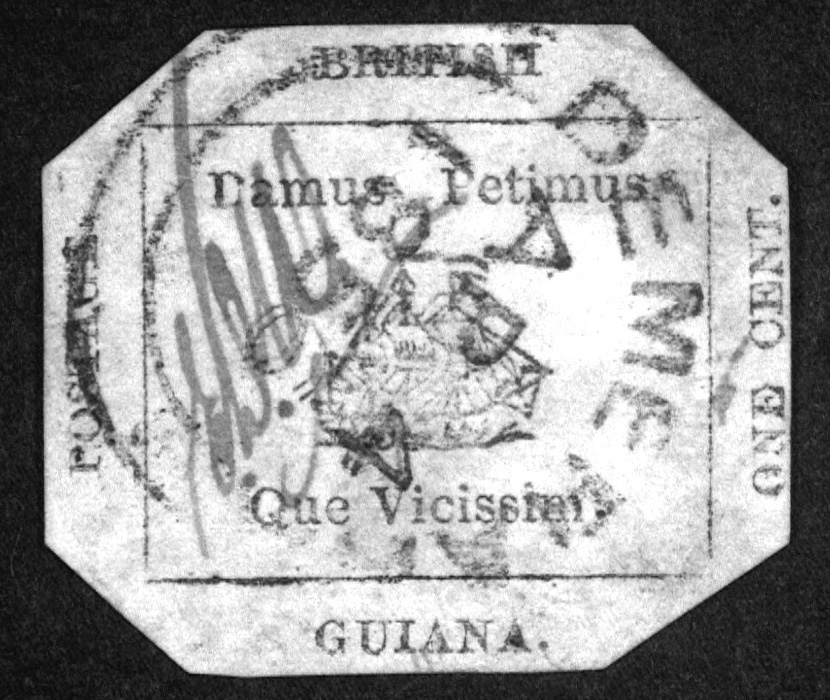
The British Guiana 1c magenta [1] was printed in the colony in 1856 [1] by a local newspaper printer after an expected supply of stamps from Britain fell short. It was a temporary measure, so few were used, and only one copy has turned up. That single survivor drives its standing. With no second copy to compare against, each sale sets the market on its own.
The Treskilling Yellow [1] comes from Sweden's first set of stamps. Its denomination was normally printed in blue-green, while yellow was the colour of a different value in the same set. Somewhere in production the wrong colour was used, and only one yellow copy has been found. It shows how a mistake at the printer can turn an ordinary low value into a rarity.
The Mauritius 2d blue (III) [1] belongs to the island's first issues, which were engraved and printed locally. Only a small number of these early Mauritius stamps survive, so lists record individual examples separately. The roman numeral identifies one particular copy with its own sale history, rather than the issue as a whole.
The Inverted Jenny Plate Block of Four [2] is a group of US airmail stamps, still joined together, on which the biplane in the centre was printed upside down. Single Inverted Jennys are already sought after. A joined block is a scarcer survival, because the error sheet was broken up and mostly sold as individual stamps.
Other postage stamps that recur on most-valuable lists
Beyond those four, the remaining places in a top ten rotate among a group of classic rarities. The names below turn up regularly in auction coverage and published rankings, although their order varies from list to list, and so does whether they appear at all:
- The Z Grill, a US issue embossed with a small grid of points meant to help the paper absorb cancelling ink. Very few copies with this particular grill pattern are recorded.
- The Hawaiian Missionaries, the first stamps of the kingdom of Hawaii. They take their name from the fact that many surviving copies came from letters written by missionaries.
- The Basel Dove, a Swiss cantonal stamp printed in several colours with an embossed white dove.
- The Sicilian error of colour, a stamp of Sicily printed in the colour intended for another value.
- The Baden colour error, a stamp of the German state of Baden printed on paper of the colour meant for a different value.
- The Whole Country is Red, a Chinese stamp withdrawn almost immediately because of how its map was drawn.
Lists that include covers also bring in items such as the Bordeaux Cover, an envelope from Mauritius that carries early stamps of the island. Whether an item like that belongs in a ‘stamps’ ranking is exactly the kind of counting decision that makes lists disagree.
Treat any list as a snapshot. A private sale that never becomes public can leave a stamp undervalued on paper. A fresh auction record can push a name into the top group overnight.

What these valuable stamps have in common
Reading across the names above, a few patterns explain why some stamps reach these levels while millions of others do not, including relatives with the same design.
Scarcity comes first. Most of these items exist as one example or a handful. A design printed in huge quantities stays affordable however old it is, while a single survivor of an emergency printing can become a landmark.
Errors are the second pattern. A wrong colour, an inverted centre or a design on the wrong paper becomes valuable only when the mistake escaped the printer's checks and very few copies reached the public. The ordinary version of the same stamp usually exists in quantity and sells for far less, so a familiar picture in your album is far more likely to be the common printing than the famous one.
Third, many of these items are early issues from small postal administrations: colonies, cantons and kingdoms whose first stamps were produced locally, in short runs, with little thought of collectors. Few people kept such stamps at the time, and that low survival rate is part of what collectors are paying for.
Finally, condition matters even among rarities. Buyers look at the same points used to grade ordinary stamps, namely centring, colour freshness and cancellation [2]. A famous piece usually also comes with an expert opinion behind it, and that opinion gives buyers more confidence than a stamp offered without one.
The clues collectors use to separate one printing from another are set out in how to identify postage stamps. They apply as much to an ordinary album as to these famous items.
How to check a stamp you think might be rare
If something in your collection resembles one of these famous items, work through the checks below in order. They come from guidance on valuable US stamps [2] and on stamp gum [3], but the same approach works for most countries.
- Describe the stamp. Identify if the stamp is definitive or commemorative, perforated or imperforate, mint or used [2]. Answering those four questions narrows the field before you open a catalogue, because catalogues separate their listings along the same lines.
- Find the matching catalogue entry. The Scott Catalogue is a standard reference for identifying US stamps [2]. For other countries, where can I find a world stamp catalogue explains your options.
- Judge the condition honestly. Stamps are graded on a scale from “Poor” to “Superb” based on centering, color freshness, and cancellation [2]. Two copies of the same stamp can sit far apart on that scale.
- Be cautious with early stamps that look unused and perfect. Gum on old stamps is not always the gum they were issued with. This means that old unused stamps in supposedly mint condition often come under suspicion of having been regummed, and the detection of regummed stamps is an important part of philatelic expertisation [3]. The background is covered in how to identify stamp gum condition.
- Get an expert opinion before any money changes hands. Using a stamp authentication service like the Philatelic Foundation or Professional Stamp Experts is advisable for verifying expensive purchases [2].
A match to a common version is the usual outcome of this process, and it is useful in itself because it tells you what you own. If what you hold instead looks like a famous error or a unique survivor, stop there and pass the question to an expert rather than reaching your own verdict.
Tip: Keep a written note for each stamp you check. Record the catalogue entry you matched, the grade you would give it and any doubts you have. If you later send the stamp for authentication or show it to a dealer, those notes speed up the conversation and show what you have already worked through.
Mistakes that cost collectors money
Warning: Do not pay a high price for a stamp sold as one of the famous rarities, or as any error, on the strength of a photo and a seller's description. Without verification from an authentication service [2], you may be buying a common stamp or a repaired copy.
Other mistakes come up often:
- Assuming a famous name fits a familiar picture. Sweden's first set exists in its normal colours, and only the single yellow copy is the Treskilling Yellow [1]. Most stamps that share a design with a rarity are the ordinary issue, so leave any claim of a match to an expert.
- Skipping the basic description. If you have not noted whether a stamp is definitive or commemorative, perforated or imperforate, mint or used [2], you can end up reading the wrong catalogue listing and drawing the wrong conclusion about what you hold.
- Using a reference that does not cover the stamp. The Scott Catalogue is a standard reference for identifying US stamps [2], so a stamp from elsewhere needs a catalogue that lists that country's issues properly.
- Assuming unused means untouched. Fresh-looking gum on an old stamp does not prove it is original, which is why regumming is something expertisers look for [3].
- Treating a catalogue figure as a sale price. Catalogue values are a reference point. What a buyer actually pays depends on condition, demand and how the stamp is sold.
- Ignoring grade. A stamp toward the “Poor” end of the grading scale [2] can be worth much less than a well-centred, fresh copy of the same issue.
- Selling in a hurry. An album sold as one lot before anyone knowledgeable has examined it can hide stamps that deserved separate attention from an expert.
Where to start with your own stamps
For most collectors, the realistic goal is not to find one of these famous pieces but to know exactly what they own. Working through identification, catalogue matching and grading for each stamp gives you that knowledge. It also shows quickly which items deserve an expert's time.
Stamp Identifier can help with the first step. Photograph a postage stamp and it suggests an identification, including country and issue details, which you can then check against a catalogue. It also gives a photo-based value estimate. Treat that estimate as a starting point for research, not an insurance appraisal or a guaranteed sale price, because condition and the exact variety still need checking. For anything that looks like a serious rarity, use the authentication route described above before buying or selling.
Common questions
- Could a stamp in an inherited album be one of the famous rarities?
- It is very unlikely, because the items at the top of these lists are tracked individually and their whereabouts are largely known. An inherited album can still hold stamps worth looking into, especially early issues, errors and well-preserved sets. If something appears to match a famous rarity, have an expert examine it before you sell or advertise it.
- Does an upside-down design or a wrong colour always make a stamp valuable?
- No. Value depends on how many copies of the error reached the public, whether the piece is genuine and what condition it is in. Some errors survive in fair numbers, and some apparent errors are fakes or alterations made after printing. Get an expert opinion before treating one as special.
- Is a catalogue value the same as what a stamp will sell for?
- No. A catalogue figure is a reference that helps you compare stamps, but what a buyer pays depends on condition, demand and the way the stamp is sold. Dealers and auction houses also have their own costs to cover, which affects what they offer.
- Why do different websites give different top ten lists?
- Lists differ in what they count and when they were compiled. Some include only single stamps, while others add covers and blocks, and each relies on the public sales the compiler chose to use. A list that was not revised after a major sale will also differ from a newer one.
- Does an old unused stamp with full gum automatically count as mint?
- Not automatically. Old unused stamps can be regummed, and spotting that is part of the work expert examiners do. For an early stamp where mint condition would make a real difference to its value, an expert opinion is the reliable way to settle the question.
Sources
Keep reading
Photo: scanned by User:Leonid Dzhepko, Public domain
How to identify a postage stamp denomination