What Stamp Sold at a Record Auction? The One-in-a-Million Inverted Jenny
The stamp that sold for a record auction sum is a single Inverted Jenny. It is a United States airmail issue whose blue airplane was printed upside down inside its red frame. Collectors call it one in a million because the error escaped the printer on only one sheet, and every copy has been tracked for generations. This guide explains how the error happened and why one particular copy fetched so much. It also covers which checks tell you whether a similar-looking stamp in your album deserves an expert's eye.
Quick answer: The stamp was an Inverted Jenny, a United States airmail stamp whose biplane was printed upside down by mistake. One exceptionally preserved copy set a record at auction. Its gum had never been hinged, its centering was sharp and its history was documented.
The stamp behind the headlines: the Inverted Jenny
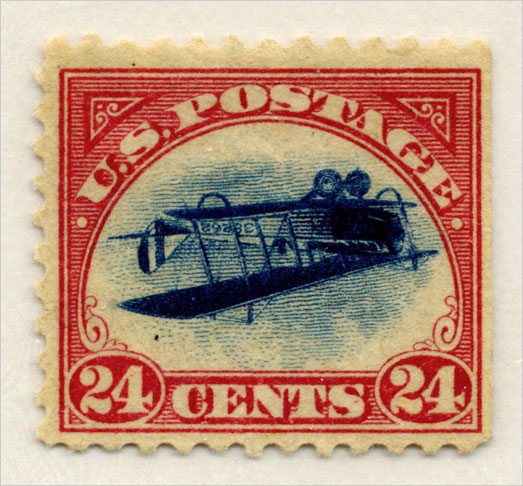
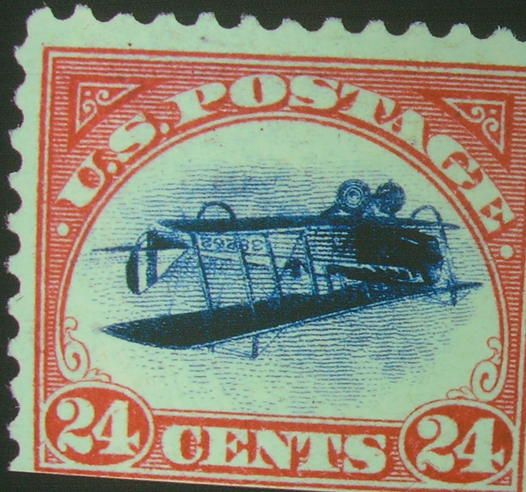
The stamp in question is the Inverted Jenny, a United States airmail issue first released in 1918 [1]. Its design shows a Curtiss biplane [2], the training aircraft that pilots nicknamed the Jenny. The plane sits inside an ornate red frame with the country name and face value printed around it. If you want to read more about how face values are shown on stamps generally, our guide on postage stamp denominations covers that. On a normal copy the blue airplane flies level across the middle of the design. On the error the plane is upside down with its wheels pointing at the sky, while the frame and lettering sit the right way up.
The issue was produced quickly to coincide with the launch of scheduled airmail flights, and the rush shows in the printing. Normal copies are not scarce. They turn up in old collections, dealer stock books and inherited albums, and they are worth a small fraction of what the error commands.
The inverted version is another matter. Every genuine example came from a single sheet of 100 [1] that was bought over a post office counter before anyone noticed the mistake. That sheet was later broken up and the stamps dispersed to private collectors.
Because the supply was fixed from the start, each surviving copy has its own identity. Specialists refer to every example by the place it occupied on the original sheet, so its ownership, any repairs and its earlier sales stay attached to it as it changes hands. Some copies have been lost, stolen or damaged over the decades, which makes the well-preserved ones even more sought after.
That continuity gives the market confidence. A buyer bidding on a top Jenny is not only buying an attractive error. They are buying a piece whose past is already part of the story, from the counter where the sheet was bought to the collections it passed through. When a copy with strong condition and a clean history comes up, collectors who have waited years for the chance compete hard for it.
How a printing error produced the inverted plane
Printing a stamp in more than one color usually meant feeding each sheet through the press more than once. One pass laid down the frame, and a later pass added the central picture, known as the vignette. If a sheet was turned the wrong way round between passes, the vignette landed upside down relative to the frame.
That is how the Jenny error arose. Some of the stamps were printed with the plane flying upside down [2], and the faulty sheet slipped past the inspections meant to catch spoilage.
Accounts of the printing suggest that other misfed sheets were spotted and destroyed before distribution. That is why the surviving error is tied to the one sheet that reached the public. The mistake was not a design choice or a deliberate variety. It was a production slip that the checking system was supposed to prevent.
Timing turned that slip into a legend. The stamp appeared just as the postal service was trying to show that letters could travel by air on a regular schedule. Aviation was new, the public was paying attention, and an airplane flying upside down on the very stamp meant to celebrate the service made an irresistible story. Newspapers picked it up, and the error became known well beyond the circle of people who collect stamps.
Errors of this kind are prized in philately because they record a moment when the system failed. A normal copy shows what the post office intended. An error shows what actually came off the press when something went wrong, and when only one faulty sheet escaped, the number of copies is fixed for good.
That fame has a downside. A design this well known invites imitation, and serious buyers expect a top copy's history to be settled long before it reaches an auction room. If you ever think you hold one, that is the moment to ask an expert rather than rely on your own judgement.
Why this stamp sold for a record sum
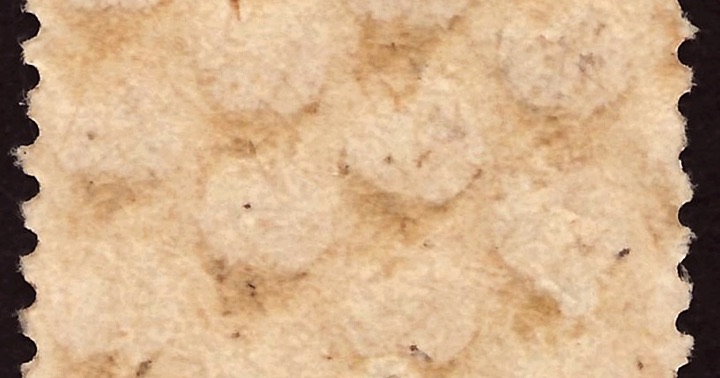
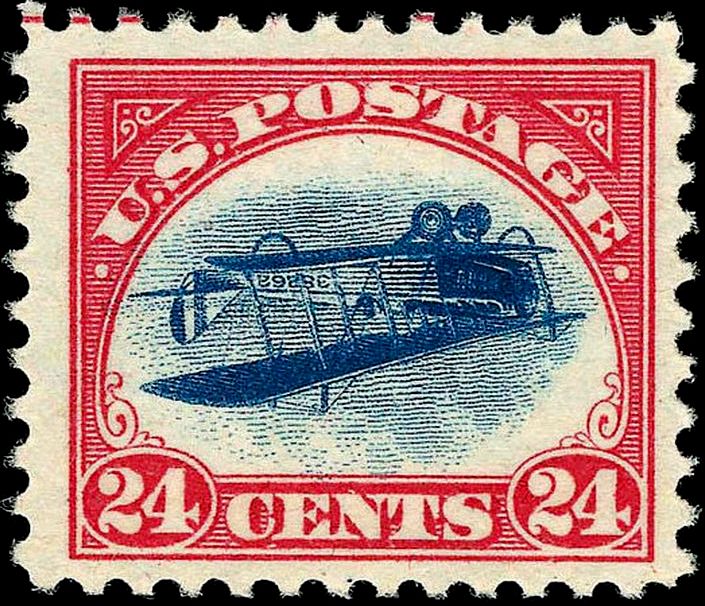
The copy that set the record was Position 49 [2]. It stood out among the surviving examples for a combination of reasons rather than any single feature.
- Untouched gum: on the back of the stamp, the gum had never been hinged and put into an album [1]. For a stamp that passed through collectors' hands for generations, that is unusual, and it removes one of the main condition doubts buyers have.
- Centering: graders score stamps from one to 100 in terms of the centering of the design with the perforations around it [2]. The perforations on this issue often crowd the design, so a well-balanced copy is hard to find.
- Provenance: its place on the original sheet tied it to a known history, so bidders were not taking its past on trust.
- Scarcity: every genuine copy is tied to one sheet, so no new supply can appear.
The table below pulls the key reference points together.
| Detail | Why it matters |
|---|---|
| Issued in 1918 [1] | Places the error at the start of scheduled US airmail |
| From a single sheet of 100 [1] | Caps the number of genuine inverted copies that can exist |
| Position 49 [2] | Identifies the record copy and links it to its recorded history |
| Centering scale of one to 100 [2] | Higher scores mean the design sits evenly inside the perforations |
The headline result was not paid for the error alone. Plenty of Inverted Jennys exist in weaker condition: hinged, regummed, repaired or poorly centered. They are still prized, but they do not reach the same level. Condition separates a strong example from an exceptional one. In a fixed population, the exceptionally preserved copies are the ones that set records.
It helps to know what those condition words mean when you read about famous sales. Hinged means a small paper hinge was once stuck to the back to mount the stamp in an album, leaving a mark or disturbed gum. Regummed means the original gum was lost and new adhesive applied later. Repaired covers anything from a closed tear to a filled thin spot. Each one moves a copy down the scale, and buyers price that in.
That pattern holds across philately. The same issue can range widely in value depending on gum, centering, faults and history. A headline sale tells you what the top of the market will pay for one particular copy, not what every copy is worth.
How to check a Jenny-type stamp you own
Three observations tell you a great deal about a Jenny-type stamp, and they are the same three features that set the record copy apart. None of them needs special equipment, only a clean surface, good light and a little patience.
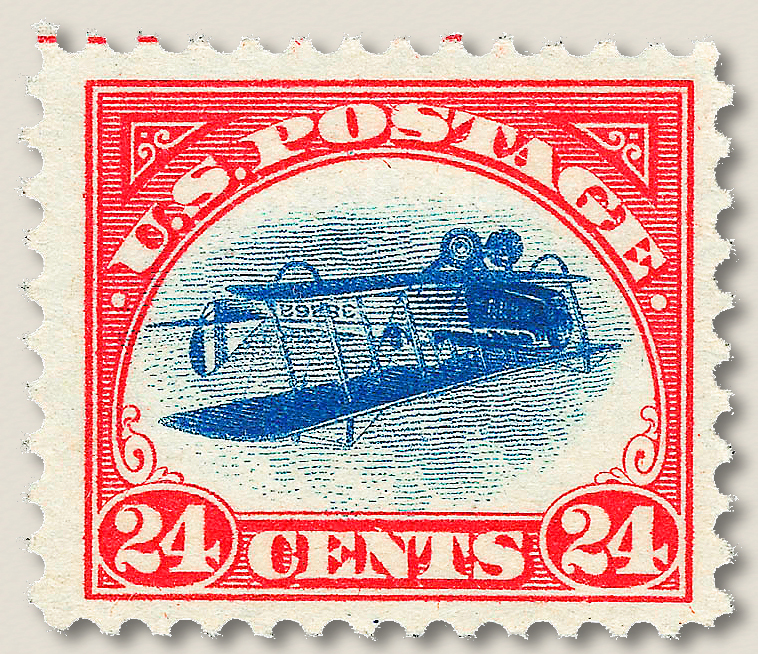
- Check the orientation. The error is defined by the plane: some of the stamps were printed with the plane flying upside down [2] while the frame stayed upright. If your plane flies level with its wheels below it, you have a normal copy.
- Turn it over. See whether the gum is untouched, the way the record copy's gum had never been hinged and put into an album [1], or whether there is a hinge mark, a disturbed patch or no gum at all. Our guide on how to identify stamp gum condition explains the terms dealers use.
- Judge the centering. Graders score stamps from one to 100 in terms of the centering of the design with the perforations around it [2]. Compare the margins on all four sides. Even margins point toward a higher grade, while a design pushed hard against one edge pulls it down.
Tip: Look at the back before anything else touches it. The gum check depends on the back being exactly as you found it, and the record copy's value rested partly on gum that had never been hinged and put into an album [1]. Write down what you see on each side so you have a record of the stamp's state before anyone else handles it.
Here is how the results usually play out. A level plane with a hinge mark and margins crowding the left side describes an ordinary copy from an old collection: a pleasant piece of airmail history with modest value. A level plane with untouched gum and even margins is a normal copy in good condition, and it is worth more than the average example of the issue. An upside-down plane is the only result that changes the conversation entirely.
If your plane really is upside down, stop there. Do not mount, clean or offer the stamp for sale. This is exactly when to ask an expert, because a claim of this size needs a specialist's opinion before anything else happens.
When you contact a specialist, pass on what your three checks showed: which way the plane faces, what the back looks like and how the margins compare on each side. Mention where the stamp came from, such as a relative's album or a dealer's lot, and whether it is loose or still attached to a page or envelope. Those notes help an expert decide how urgently to look at it and save time on both sides.
Keep your expectations realistic. The genuine inverted copies come from one known sheet and their histories are followed closely, so a newly surfaced one would be extraordinary. A normal copy in good condition is still a worthwhile addition to a collection, and the same three checks tell you how good it is.
Mistakes that cost money or damage a stamp
Warning: Do not hinge, soak, wash, flatten or trim a stamp you think might be valuable. Once a hinge has been applied, the gum can never again be described as never hinged and put into an album [1], and the copy drops into a lower condition category. Soaking removes original gum entirely. Trimming perforations to make the centering look better is treated as damage, not an improvement, because the one to 100 scale judges the design against the perforations as they were made [2].
Other mistakes are less dramatic but still costly:
- Judging by the front alone. A stamp with a sharp design can still have a hinge mark or disturbed gum on the back, and that changes how buyers see it. The record copy's back, where the gum had never been hinged and put into an album [1], mattered as much as its face.
- Assuming any upside-down picture means a fortune. An unusual-looking design is a reason to ask an expert, not a reason to celebrate or spend money on the stamp.
- Reading a headline as a price list. A record set by one exceptional copy says nothing about a hinged or off-center normal copy. Sellers who quote the headline when pricing an ordinary Jenny are misleading buyers, knowingly or not.
- Selling in a hurry. Offering a suspected rarity to the first interested buyer can mean accepting far less than it is worth, and it can lead to a dispute later if the stamp proves to be something other than it seemed.
- Splitting pieces that belong together. If a stamp is still attached to an envelope, a block or an album page with notes from a previous owner, keep it that way until you know what you have. Separating them can throw away part of its history.
Each of these mistakes is easy to avoid by pausing. A stamp that has survived for generations will survive a few more weeks while you find out what it is. A rushed hinge, a soak in water or a quick sale cannot be undone.
How the Inverted Jenny compares with other rarities
The Jenny belongs to a small group of stamps whose value comes from a printing error rather than from age or a small print run alone. Other famous rarities owe their status to different causes:
- some are unique survivors
- some are color errors printed in the wrong shade
- some are provisional issues made locally in small quantities
Our overview of valuable postage stamps sets out those categories with examples.
What sets the Jenny apart is how easy the error is to understand. You do not need specialist knowledge to see that the plane is upside down. That visual simplicity has made the image widely recognised outside the hobby, which broadens the pool of people who want to own one.
The comparison is also useful because it shows the questions that decide value at the top of the market. Is the error or rarity genuine? How many examples exist? What is the condition of this particular copy? Is its history documented? Applied at a more modest level, the same questions help you think about ordinary stamps in your own albums. They also explain why two copies of the same issue can be valued very differently.
There is a practical lesson in that for everyday collecting. The famous rarities are out of reach for most people, but the condition standards that decide their prices apply to every stamp. Learning to read gum and centering on common issues builds the eye you would need if something unusual ever did cross your desk.
Applying the record copy's lessons to your own stamps
Few collectors will ever handle an Inverted Jenny, but the habits that protect a record-setting copy are worth applying to every stamp you own. Look at the gum on the back before anything touches it [1], judge how the design sits within the perforations [2], and ask an expert when something looks unusual.
Keeping a record helps those habits stick. Stamp Identifier lets you build a digital catalog of your stamps with photos and notes, so you can log the gum and margins as you found them, and its photo-based value estimate is a starting point for research, not an appraisal or a guaranteed sale price. For anything with an upside-down design or another feature that looks like a major error, take it to an expert before you sell, insure or mount it.
Common questions
- Which stamp set the record that people talk about?
- It was a single copy of the Inverted Jenny, the American airmail stamp with its plane printed upside down. The record copy combined untouched original gum, strong centering and a well-documented history, which is why it outsold other examples.
- Is every Inverted Jenny worth the same as the record copy?
- No, copies that have been hinged, regummed, repaired or poorly centered still attract serious interest but sell for less than a well-preserved example. Condition and history decide where each copy falls.
- Could I have a genuine inverted error in an old family album?
- It is very unlikely, because the genuine copies come from one sheet and specialists follow their histories closely. If you find one with the plane upside down, avoid handling it further and ask an expert for an opinion.
- Are normal copies of the Jenny airmail stamp worth collecting?
- Yes, they are an attractive and historically important issue that is far easier to obtain than the error. Their value depends on gum, centering and faults, so the same checks used for the rarity apply to them too.
Sources
Keep reading
 AI illustration
Photo: scanned by User:Leonid Dzhepko, Public domain
How to identify a postage stamp denomination